

What if your symptoms, struggles and recurring patterns aren't signs that something is wrong with you, but invitations to understand yourself more deeply?
Have you ever felt like something was wrong with you?
Perhaps your body keeps producing symptoms you can't seem to resolve. Perhaps you repeat the same emotional patterns, struggle with anxiety, or feel disconnected from yourself despite everything you've tried.
I believe meaningful healing begins when we stop looking at symptoms in isolation and start looking at the whole person. Our physical health, thoughts, emotions, nervous system, relationships and deeper sense of self constantly influence one another.
In brief
Body, mind, heart and soul influence one another, so addressing only one often leaves part of the picture unseen.
Research on stress physiology, immunity and gut–brain signalling supports this interconnection, but it does not mean every symptom has an emotional cause.
"Never broken" does not mean "never in need of medical care". Appropriate assessment and treatment always come first when needed.
Healing tends to unfold in stages: building a foundation, processing, and integration.
A note before we begin. Feeling that you are not broken is not the same as saying nothing needs attention. Some symptoms have medical explanations that deserve proper investigation, and this article is not a substitute for that care. What I hope to offer is a wider lens, one that works alongside good medical care rather than instead of it.
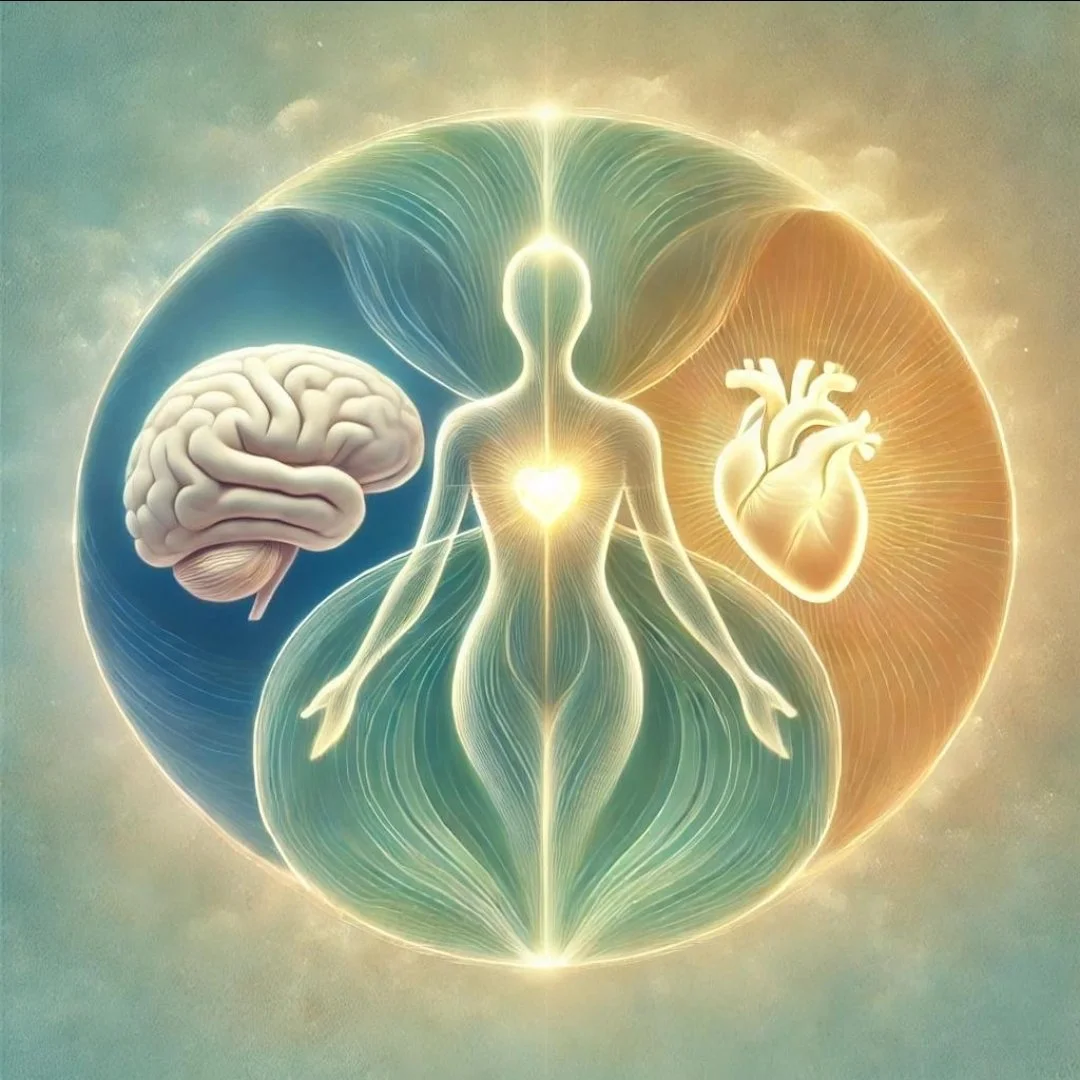
Four interconnected dimensions
The idea that health is shaped by biological, psychological and social factors together is not new; it underpins the biopsychosocial model proposed by Engel (1977). In my work I describe four dimensions: Body, Mind, Heart and Soul. None exists in isolation, and each can influence the others.
1. The Body: your physical foundation
The body is where we experience life physically. Genetics, nutrition, gut health, hormones, immune function, sleep, lifestyle and environment all contribute to wellbeing, and physical symptoms often have several contributing factors worth exploring rather than simply managing.
The body is also shaped by experience. Prolonged activation of the stress response can wear on physiological systems over time, a process described as allostatic load (McEwen, 1998). Supporting the body means creating the foundations for health and giving it the resources to function and recover.
2. The Mind: understanding the patterns beneath the surface
Our beliefs, thoughts and learned responses shape how we interpret the world and respond to challenges. Many of these patterns develop early. They may have helped us feel safe, belong or avoid conflict, but what once protected us may not serve us as adults. You might notice overthinking, people-pleasing, self-doubt or a constant anticipation of danger.
Understanding these patterns is not about blame or forced positivity. It is about awareness, curiosity and gradually creating new options.
Our thinking is also tied to our physical state. Stress across the lifespan affects the brain, cognition and behaviour (Lupien et al., 2009), which is why clear thinking and emotional flexibility can be harder when we are exhausted or overwhelmed.
3. The Heart: making space for emotional healing
Grief, fear, anger, shame and unmet emotional needs shape how we experience ourselves and the world. Many of us learn to suppress what we feel and keep functioning because life has required it. We become very good at coping, but not necessarily at feeling.
Emotional healing is not about endlessly revisiting the past. It is about creating enough safety to acknowledge, process and integrate our experiences at a pace that feels right. Emotions are also felt in the body: when people are asked to map where they feel different emotions, their maps are remarkably consistent across cultures (Nummenmaa et al., 2014).
4. The Soul: reconnecting with who you are
Unlike the other three dimensions, the Soul is not something I measure. It is a personal and philosophical idea. For me, it represents our authenticity, sense of purpose and inner knowing.
This part of us can become harder to hear when life is dominated by survival, expectations and external approval. We may achieve, perform and care for others while still feeling that something is missing. Reconnecting with ourselves means making room to discover what genuinely feels aligned, and the connection runs both ways: when body, mind or heart are under strain, it can be harder to feel connected to our values, and reconnecting with what matters often changes the choices we make for our wellbeing.
What does the research say?
Modern science increasingly shows how interconnected our physiological and psychological processes are.
The gut–brain axis describes two-way communication between the gastrointestinal system and the brain through nerves, immune signalling, hormones and the gut microbiome (Cryan et al., 2019).
Psychoneuroimmunology studies how psychological processes, the nervous system and the immune system interact. Evidence links chronic stress with changes in immune function (Kiecolt-Glaser et al., 2002; Segerstrom & Miller, 2004).
Adverse childhood experiences have been associated with a higher risk of a range of adult health problems (Felitti et al., 1998).
These findings do not mean every symptom is caused by stress or trauma, nor that emotional work alone can resolve every health condition. They show that health is influenced by many biological, psychological and environmental factors at once, which is why understanding their relationship helps us see the bigger picture.
What does integrative healing mean?
Integrative healing means recognising that there is rarely one explanation or one universal solution. Two people with similar symptoms can have very different contributing factors, histories and needs.
My work brings together naturopathic medicine, root cause exploration, and emotional and somatic approaches, depending on the person. By root cause exploration I mean investigating the contributing factors behind a symptom, such as nutrition, sleep, hormones, stress load and life history, rather than only managing the symptom. It is a process of inquiry, not a promise of a single cause or a cure.
Sometimes the focus is mainly physical. Sometimes it is emotional experience, nervous system responses or long-held beliefs. Often it is a combination. There is no need to force every approach into every session.
Healing is a journey, not a single breakthrough
In my experience, meaningful change often unfolds in three stages.
Building the foundation. Creating stability, supporting physical health, developing awareness and establishing the resources needed for the process ahead.
Processing and healing. Working with the experiences, emotions and patterns that may be contributing to ongoing struggles, always at a pace that respects individual readiness and capacity.
Integration. Allowing change to become part of everyday life, with new ways of responding, relating and choosing.
You were never broken
Perhaps you have spent years trying to fix yourself, following protocols, reading books and working hard to change your circumstances, and wondered why the pieces still don't quite fit.
You don't need to approach yourself as a collection of things to fix. You can begin by becoming curious about your experiences, listening to what your body may be communicating, understanding your patterns and making space for the parts of yourself that have been overlooked.
You are not just a body, and you are not just your thoughts, your emotions or your past. You are an interconnected whole.
You were never broken. Perhaps you've simply been looking at yourself through too narrow a lens.
About Olga
Olga Bokalova, BHSc, Naturopath & Integrative Healing Practitioner, is the founder of Body Mind Heart Soul Integrative Healing. She brings together naturopathic medicine, root cause exploration, and emotional and somatic approaches to support individuals towards greater wellbeing and self-understanding.
Ready to explore your own healing journey? Book your initial consultation or explore Olga's integrative healing approach.
Disclaimer: This article is for general educational and informational purposes only. It is not intended to diagnose, treat or replace individual medical advice. Please consult an appropriately qualified healthcare professional regarding your health concerns.
References
Cryan JF, O'Riordan KJ, Cowan CSM, et al. The Microbiota-Gut-Brain Axis. Physiol Rev 99: 1877-2013, 2019. doi: 10.1152/physrev.00018.2018.
Engel GL. The need for a new medical model: a challenge for biomedicine. Science. 1977 Apr 8;196(4286):129-36. doi: 10.1126/science.847460. PMID: 847460.
Felitti VJ, Anda RF, Nordenberg D, Williamson DF, Spitz AM, Edwards V, Koss MP, Marks JS. Relationship of childhood abuse and household dysfunction to many of the leading causes of death in adults. The Adverse Childhood Experiences (ACE) Study. Am J Prev Med. 1998 May;14(4):245-58. doi: 10.1016/s0749-3797(98)00017-8. PMID: 9635069.
Kiecolt-Glaser JK, McGuire L, Robles TF, Glaser R. Psychoneuroimmunology: psychological influences on immune function and health. J Consult Clin Psychol. 2002 Jun;70(3):537-47. doi: 10.1037//0022-006x.70.3.537. PMID: 12090368.
Lupien SJ, McEwen BS, Gunnar MR, Heim C. Effects of stress throughout the lifespan on the brain, behaviour and cognition. Nat Rev Neurosci. 2009 Jun;10(6):434-45. doi: 10.1038/nrn2639. Epub 2009 Apr 29. PMID: 19401723.
McEwen BS. Protective and damaging effects of stress mediators. N Engl J Med. 1998 Jan 15;338(3):171-9. doi: 10.1056/NEJM199801153380307. PMID: 9428819.
L. Nummenmaa, E. Glerean, R. Hari, & J.K. Hietanen, Bodily maps of emotions, Proc. Natl. Acad. Sci. U.S.A. 111 (2) 646-651, https://doi.org/10.1073/pnas.1321664111 (2014).
Segerstrom SC, Miller GE. Psychological stress and the human immune system: a meta-analytic study of 30 years of inquiry. Psychol Bull. 2004 Jul;130(4):601-30. doi: 10.1037/0033-2909.130.4.601. PMID: 15250815; PMCID: PMC1361287.